Wednesday, August 17, 2016

Feminine Cool! Vivre Sa Vie


Vivre Sa Vie ( released in 1962) was French Filmmaker Jean-Luc Godard's third film and a deceptively simple one.  The title (translated as My Life To Live) is both an affirmation of life and a question. Is it possible to be a true individual? The story is of a female, Nana (played by Godard's wife Anna Karina), and follows her in twelve short chapters.  As were all of Godard's females, Nana is blase and somewhat detached from society, the men in her life are not important because they show her nothing worth paying attention to. 

Godard observes Nana's daily routines using a documentary feel that beautifully captures the subtle nuances that make up Nana as a person.  She doesn't always make good choices and her life is not a conventional one, but no one can seem to give her any useful help or advice. 


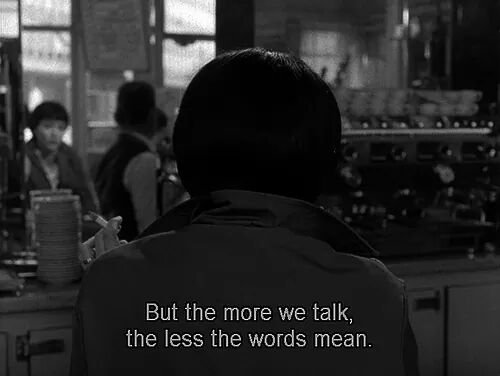
 Worth noting and paying attention to are Vivre Sa Vie's  unique and fresh dialogue scenes.The five minute opening scene between Nana and her estranged lover Paul is shot from the back of their heads as they sit at a counter having coffee. The activity of the cafe reflects in a mirror. So what we have are three different visuals; the backs of the heads, the action behind the counter, and the action in the mirror. During another conversation the camera simply strolls over to the right and displays the busy world of Paris through a cafe window. Roger Ebert had this to say about Godard's camera style: "His camera rotates 360 degrees, twice, and then stops and moves back in the other direction - just a little to show it knows what it's doing!"


Adding to the clever dialogue scenes, music drops in from nowhere at odd times, as if it were a Greek Chorus making Nana's journey to self both mythic and tragic . One of Vivre Sa Vie's iconic sequences is an extended dance scene capturing Nana with a handheld camera as she struts around a pool room defying three irritated men in her outburst of life. And it isn't just these three men she is defying, she is daring the audience to judge her.

Anna Karina and Godard's camera operator Raoul Coutard capture pure beauty in the following clip of Nana's dance scene:


Vivre Sa Vie opens with a quote: “Lend yourself to others, but give yourself to yourself.” - from the essays of Montaigne, Book 3, Chapter 10. This quote works in the same fashion as the title. In reference to the film, Godard is both making a statement and posing a question; is this possible?
There is a childish joy inside Nana but Godard and his camera always remind us of the world outside waiting to steal it.

Anna Karina and Jean-Luc Godard at the 1963 Cannes Film Festival

This is my fourth installment of The French New Wave movement. To read more about this check out my blogs on Elevator To The Gallows, Breathless, and The 400 Blows.


Inspired further reading:

Roger Ebert's review from his list of Great Movies
http://www.rogerebert.com/reviews/great-movie-vivre-sa-vie--my-life-to-live-1963 

Vivre Sa Vie: The Lost Girl by Michael Atkinson
https://www.criterion.com/current/posts/1441-vivre-sa-vie-the-lost-girl 

An Audacious Experiment: The Vivre Sa Vie Soundtrack by Jean Collet
https://www.criterion.com/current/posts/1442-an-audacious-experiment-the-soundtrack-of-vivre-sa-vie 
 

Wednesday, August 3, 2016

Fritz Lang and The Three M's


Germany in the 1920's . The Weimar Republic was a hub of artistic expression and the population eager for change in the aftermath of WWI. Filmmakers were creating a new cinematic language referred to as the German Expressionist Movement. Films applied askew camera angles, outlandish set pieces, eccentric characters, and stories that dealt with the landscape of the mind. Control, murder, paranoia, fear, madness, and betrayal were all reoccurring themes and no one expressed these ideas better than director Fritz Lang.

Fritz Lang on the set of M.


I have chosen three films that demonstrate Lang's themes and talent as a visual filmmaker. The Three M's, as I call them, are; Metropolis, M, and Ministry Of Fear. Lang is thought of by many film scholars as a prophet with spiritual and political insight. It is easy to see his vision of a world on the verge of collapse in these three films.

Sketch for the set design of M.


Lang's groundbreaking Metropolis (1927) showed audiences a society where the rich live carefree and gluttonous above ground while underneath, slaves toil endlessly to keep the machines of the great metropolis operable. Metropolis creates a stark contrast between the beautiful architecture of the elite society and the dark machine world of the slaves.


The underground slaves arriving for work in their smoke stack machine.

 
A robot made in the form of a human and surrounded by "circles" of power in Metropolis

  Geometry was central to Lang's style ; angles and shapes express feelings. Most prevalent are the repetition of circles that work against the sharp pointed lines of the buildings and interior set pieces. The characters are often surrounded by extreme inanimate objects or crowds of people, buildings or smoke filled machines, creating claustrophobia and the feeling that both the rich and the poor are trapped in these shapes and doomed to repeat their history. 


Cityscape for Metropolis which no doubt influenced the cityscape in Riddley Scott's Blade Runner (pictured below)


1931 brought the electrifying and horrific M, the story of a child murderer (Peter Lorre) and the hysteria created in a small town while authorities and criminals try to apprehend him. This was Lang's first film with sound and one in which sound becomes a character. Noises such as continuous whistling, screams, car horns and motors, off-putting crowd chatter jar our ears and disrupt the action. To shake our footing even further some of the main sequences are shown in complete silence.

The first shot of the killer in M, a shadow on his Wanted poster.

Camera angles are high and ominous or low and subjective, showing reactions of the peasant crowds and criminals when they encounter the police, who continuously try to reestablish their authority in a town gone mad with panic.


Peter Lorre as Hans Beckert, serial child murderer in M.
In 1933 Hitler seized control of the Weimar Republic. Lang and other German filmmakers then emigrated to Hollywood where they formed partnerships with studios and changed the face of 1930's and 40's Hollywood. 1944's Ministry of Fear was indeed Fritz Lang's anti-Nazi statement and also a warning not to trust anyone in a position of power.   

Ray Milland as the helplessly trapped Stephen Neale in Ministry Of Fear.

The film follows Stephen Neale (Ray Milland) as he is released from a mental asylum in London and unwittingly wanders into a world of spies and Nazis. Clocks and other circles are used to alliterate the concept of time, as time becomes increasingly important throughout the story while Stephen Neale scrambles to clear himself of the mess he is in. 

A clairvoyant (Hillary Brooke) seems to seal Stephen Neale's fate at a seance.
Ministry Of Fear is unique as a mystery in that it is not a complex puzzle where all of the pieces fit together but rather a surreal nightmare where almost nothing makes sense. The hero is a victim and his contacts are duplicitous. Shadows creep onto white walls and characters emerge from dark backgrounds. No one and nowhere is safe.


Fritz Lang's influence on modern film:

M is used today in film schools as a blueprint for thrillers and a how-to for the pacing of suspense and tension. Metropolis can be seen in numerous works; Ridley Scott's Blade Runner(1982), The Wachowski's The Matrix (1999), Terry Gilliam's Brazil (1985), and Stanley Kubrick's 2001: A Space Odyssey(1968). Fritz Lang's Hollywood career, along with fellow German exiles Otto Preminger and Billy Wilder, contributed to the core elements of what would become known as Film Noir.  Metropolis is now streaming on Netflix. M and Ministry of Fear can be purchased in stunning reissues by The Criterion Collection. 

Fritz Lang
For Further Reading:

These articles appear on The Criterion Website.

Paranoid Style
https://www.criterion.com/current/posts/2690-ministry-of-fear-paranoid-style 

The Mark of M
https://www.criterion.com/current/posts/350-the-mark-of-m 

On Fritz Lang in the 1940s
https://www.criterion.com/current/posts/2692-on-fritz-lang-in-the-1940s 
 

Tuesday, July 5, 2016

Fellini's 8 1/2 (the reality in unreality)


 Federico Fellini's 1963 surrealist cinema masterpiece 8 1/2 lets us know within four minutes that we are in for a profoundly unique viewing experience. The first shot of the film's main character, Guido Anselmi, is from behind as he sits at the wheel of his car in an endless traffic jam.  The camera then moves with serene fluidity across the top of the car to show a bus. Passengers of the bus hang their arms from the windows lifelessly - we do not see their heads.  Inside of Guido's car a gas of some sort emits from the glove box. Guido struggles to get out of the car. Passengers of the other cars watch him with silent indifference. There are no car horns, no chatter, just silence.


 Guido kicks in the passenger window of his car and then floats above the traffic jam, spreading his arms like a messiah as he drifts through the clouds and above a beach, only to find a rope tied around his foot and at the end of the rope, on the beach, someone is flying him like a kite.
CUT TO: A dark room where a hand suddenly reaches up and a man YELLS! A doctor enters the room and we see Guido awaking from a nightmare. He looks haggard and exhausted. We learn that Guido is a famous Italian director retreating to a Spa for a sabbatical while he gets his frazzled mind together and attempts to prepare for his next film project. The length of his stay in unknown and his condition is obvious. He is a man in the verge of a nervous breakdown

Marcello Mastroianni as Guido

Fellini applied make-up and streaks of white hair to transform the handsome Marcello Mastroianni into the frail Guido. But make-up aside, the performance is all Mastroianni. As the frantic and overwhelmed Guido, greeted daily by hordes of people who have come to interrupt his sabbatical, Mastroianni is a joy to watch. Guido juggles his agent, his screenwriter, actors, and his producer - all of whom want to know what his next movie is going to be about and when it is to commence. The dilemma Guido faces is that he doesn't know.
Director Federico Fellini
 Fellini brings Guido's crumbling world of chaos to us in stunning black and white with a revolving camera in a constant state of motion. Actors parade into frame and out of view as the camera becomes a character; an objective and subjective viewer that doesn't show us reality but the reality of Guido's mind. The Characters from Guido's past interact freely with the characters in his present. Guido averts his attention from one to the other while the camera moves in whirling circles. When the women of Guido's life come to visit, they too are treated as equal and expendable characters in his life's film. His wife, mistress, and lead actress (also a mistress) enter and exit with the same importance. Guido cannot choose between them anymore than he can decide what his next project must be.
Claudia Cardinale as Guido's actress Claudia

Only Claudia, his leading actress, can see past the confusion and circus that Guido purposely concocts to divert his onlookers. Her eyes look at us the audience with a knowing, mischievous grin. Actress Claudia Cardinale, like Mastroianni, provides a wealth of information through her expressions. She is the only one who can see the real Guido, the Guido behind the director.  And as we the audience sense this, we can't help but wonder which Guido we are perceiving. Or, is there a "real" Guido at all? Maybe his unreality is actually him. A man trapped inside his own vision of what the world is. Such questions are only part of the fun. The real fun is the ride of 8 1/2 and it is a ride that doesn't slow down.
 
Guido the director
 Last year when I watched the Oscar Winning Birdman starring Michael Keaton, it was impossible not to think of 8 1/2. Keaton's character goes through a similar mid-life crisis/breakdown that is filmed with no distinct line between the real world and hallucination. Birdman captures the world of theater rather than the world of film, but the influence of 8 1/2 is undeniable. Director Alejandro G. Inarritu even uses Fellini's concept of a camera in motion to sever connections between illusion and reality.  8 1/2's influence can also be seen in the following recommended films:  Bob Fosse's All That Jazz, Woody Allen's Stardust Memories and Midnight in Paris, David Cronenberg's Naked Lunch, Terry Gilliam's Brazil and Fear And Loathing In Las Vegas, David Lynch's Erasherhead, and Danny Boyle's Trainspotting. 

Michael Keaton and his "imaginary" Birdman self 
(8 1/2 is now streaming on Hulu!)


Saturday, May 21, 2016

The French New Wave pt. 3 "The 400 Blows"


(French poster for The 400 Blows)
In the late 1950's  a group of young French directors (Francois Truffaut, Jean- Luc Godard, and Louis Malle) ushered in an audacious new film movement free of constraints and stale literary traditions. Rebellious in tone and brimming with artistic integrity,  these movies seemed to have no rules or structure. They were films about ideas and people, about places and busy crowds. They challenged religion and morals, inventing a new moral code to be measured against only one judge - the cinema. This artistic explosion become known as The French New Wave and would bring about universal change in both the way audiences perceived films and how filmmakers approached them. Truffaut is believed by many critics and film enthusiasts to be the true founder of the French New Wave movement, kicking everything off to a roaring start with his debut film The 400 Blows ( a vernacular of common phrases meaning, "to raise hell").

(Actor Jean-Pierre Leaud)

The 400 Blows was released in 1958. Truffaut was 27 and already in full form as a powerhouse filmmaker. What's astonishing about this film is it's simplicity and how engaging that simplicity is. The star is Jean-Pierre Leaud (playing 12 year-old Antoine Doinel), and the locations are his hovel of an apartment, the school he attends, and the chilly streets of Paris. Nothing in this film is done out of manipulation, no pandering or catering to baser instincts. What I found as a viewer, was not a depressing or morose portrait of a disparaged youth, but an exciting and heartbreaking adventure. I was spellbound.


The film opens with a series of moving shots around Paris accompanied by charming and whimsical classical music, as if we were in a car watching the city float by and perhaps anticipating meeting the characters that inhabit it. After these shots of magnificent buildings, homes, streets, and busy commerce the film takes us directly into a boring classroom where we meet Antoine Doinel (Jean-Pierre Leaud). Shot in black and white, the film draws us in to the world of young Antoine and never do we leave his viewpoint. Our first glance of him is an over the shoulder shot, at three quarter view and we don't really get a close up until 15 minutes into the film, where he stands dejected and looks to the side of the camera. The filming of Antoine is important because the camera simply seems to observe him and everyone else he engages with. As an audience we have "dropped in" to observe without judgement.  From school, Antoine journeys to a small apartment with his parents who are busy being unaware and disconnected. His mother is trying to look young and is having an affair. His stepfather tries to be "one of the guys" with Antoine, talking casually and not knowing exactly how to be a father.  The next day Antoine and a fellow classmate meet while both skipping school and together they wander the streets eventually passing the day at a movie theater. Truffaut takes care in holding on the shot of young Antoine being hypnotized by the movie screen. The director said that this film was taken from his own life and that cinema saved him from a life of crime.

(Director Francois Truffaut and his lead actor)
Antoine searches for a place to belong, someone to look up to. He has no mentors to speak of so he attaches himself to the famous French writer Balzac. Antoine lights a candle in front of a picture of Balzac and the candle sets fire to the picture. The fire spreads, sending his mother and stepfather into a panic trying to put out the blaze; a poignant scene that could be played for drama but winds up as comedy. The family resumes the scene by laughing and going to see a movie. Once again we see Antoine in a movie theater where his true connection resides. This is just one example of Truffaut's original approach in handling familiar material already immortalized by Charles Dickens in Oliver Twist and Charlie Chaplin in The Kid..
(Antoine with his mother and stepfather)
Truffaut is indeed influenced by the iconic works of  Dickens, Chaplin, and even Alfred Hitchcock. He makes his love for Hollywood cinema known with interludes of romantic music and scenes of comedy like the one just mentioned. Even his camera work occasionally diverts from the freestyle  onlooker's viewpoint, moving into traditional perfectly framed Two Shots, Tracking Shots,  and Close Ups. Truffaut reminds us with these shots that we are watching a movie and the first rule of cinema is entertainment.
Near the end of the film Antoine has dipped his toes into the life of petty crime.  His parents have thrown up their hands and decide that only the police can handle him; his fate is left in the hands of a detention center. Antoine is then hauled away in a police wagon with hardened criminals. His destitute young face looks around with searching tearful eyes from behind the bars of the wagon's window (one of the first shots where Antonie looks toward the camera). Even in this shot, it isn't as though he is looking at us the viewer but to the world he is leaving behind.  This leads us to an exciting and uplifting climax with one of the most famous final shots in film. Antoine is running on the beach and does look directly into the camera and at us this time. He stops in a Freeze Frame Medium Close Up with a questioning look of rebellion and wonder. We have no idea what is in store for him and neither does he. Truffaut, with this single final shot, encapsulates the film's entire theme of what it means to not belong but to also not give up the search for meaning and hope.
The 400 Blows was a huge success at the 1959 Cannes film festival, where the  unknown actor Jean-Pierre was paraded on the shoulders of the prestigious French audience. The 400 Blows also began a brilliant career for Francois Truffaut who's following films continued to be brave and unrepentant in their honesty, yet playful and entertaining in their celebration of humanity. Truffaut's complicated love triangle Jules and Jim (1962) is also noted among the most influential films of the French New Wave.  Both Jules and Jim and The 400 Blows are streaming now on Filmstruck!
(Jean-Pierre being praised at the 1960 Cannes Film Festival)


Tuesday, December 16, 2014

The French New Wave pt. 2 "Elevator To The Gallows"

In 1958, twenty-three year old Louis Malle released his debut film Elevator to the Gallows. A film with a now legendary soundtrack by Miles Davis and starring the glamorous Jeanne Moreau. Elevator to the Gallows broke boundaries set by traditional Hollywood films while staying true to the conventional three Act structure, using plot elements to entertain and "play" rather than cater to viewers and accommodate their expectations.
In an essay on Gallows, Roger Ebert says in many ways he considers this film to be the start of the French New Wave. A film movement that included the following rules: no film sets(making use, rather, of actual locations), naturalistic actors (de-glamoirizing the actors image), and moveable lighting set-ups to facilitate free flowing and moving camera shots. All  usually done on a meager budget. Today this technique is almost always used in Independent Film Making or "Indie Films".
Gallows opens with a man and a woman professing their love to one another, both talking into a phone. They have plans to run away together. This is all we know. The man, Julien Tavernier, goes about his day at the office. As we follow his activities we notice he is preparing a grappling hook, a gun, and a rope. For what? He proceeds to climb up the outside of his window to the window above, using the grappling hook and rope. Julien then murders his boss, who we quickly realize is the husband of the woman he is in love with, Florence Carala.
Florence waits patiently at a cafe while Jules gets in the elevator to leave the scene of the crime. As the elevator goes down, the building's security guard shuts the power off for the evening and our protagonist is stuck between floors and near the top of the tall building. This is the set up, which boldly prepares us for a clever series of events that does not fall short in delivering.

Julien is played smoothly by Maurice Ronet. He is undaunted by the pitfalls he encounters while trying to get to his love. Nor does he once go to pieces over the crime he has just committed. He is a man with a mission. Jeanne Moreau plays Florence with the desperation and insanity of a woman helpless, waiting and wandering the streets of Paris under the relentless spell of manic love.
Director Louis Malle chose to shoot Jeanne Moreau with natural lighting and in close-ups with minimal make-up. Moreau was a French film darling at the time and this choice so enraged lab technicians that they even refused to process the film! There are plenty of supporting characters that I do not mention because to mention them would also spoil the twists and turns in the plot. Each character adds another layer and another world.

There is a spontaneity to the pacing of Gallows that, like many French New Wave films, seems unplanned and improvised - a "free form" structure that keeps the viewer spellbound. Also understatement is key here. We are meant to observe everything but be distracted by nothing. A contrast to today's films where we are spoon fed plot developments while simultaneously being beat over the head with overt messages that would be so much more enjoyable if weaved into the subtext.  Less is so much more with Elevator to the Gallows. 


Monday, July 21, 2014

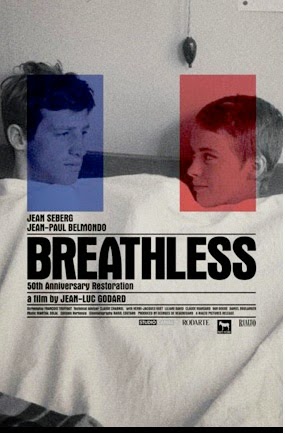
The French New Wave pt.1 "Breathless"


In the 1960's film goers who wanted something different to talk about over drinks and dinner flocked in droves to see films like Breathless by Jean-Luc Godard, and Jules and Jim by Francois Truffaut.  These films were hip and groundbreaking, thought provoking, and fun. They showed cool people doing and saying cool things. It's hard to believe it now, but Breathless was the Pulp Fiction of the 60's.  Breathless ushered in a new kind of film making. Jean-Luc Godard was a rock star and his films played like a punk concert.  The characters in the films displayed morals as loose as the roaming camera work. Scenes were shot on location (busy city streets, cafes, record stores, cheap hotels). No extras were employed and no sets were built. The style of film making was branded The French New Wave (or simply New Wave).


The Plot of Breathless is a spin on the American crime drama. A French Hood , Michel (Jean-Paul Bemando), shoots a police man in Marseilles while trying to steal a car. While on the run he turns to his American girlfriend, Patricia (Jean Seberg), who lives in France. Patricia is an aspiring journalist who sells newspapers on the street corner. She spends much of the film contemplating whether or not she is really in love with Michel. She reluctantly hides him out in her apartment as they ponder their relationship and the relationship between men and women in general.  Michel aspires to be like the screen hero Humphrey Bogart, aloof and unaffected. Able to remain detached when it comes to women and life. He constantly makes comments about his disregard for love and people. Patricia listens mostly and shrugs him off, then shoots back with her own witty retorts. She is truly the one who is detached. She says it all with her seductive, capricious eyes and coy smile. She toys with the idea of being in love with Michel, as if it were something she could take or toss away.  Even when telling him she is pregnant with their child. Patricia doesn't seem particularly loyal or committed to him.

( Writer,Director Jean-Luc Godard)

This aloof and ambivalent attitude toward life, love, and society was groundbreaking at the time. People went to see movies where the hero was tough and cool but had a moral compass, and the women were sexy and stunning but always stood by their man while taming the bad boy in him. Breathless has none of that. Michel is not as tough as he believes, although his contempt for anything in society plays as cool and smooth. We laugh as he insults everything life has to offer (including one scene where he is in his car and looks directly into the camera to rant about bad drivers and how much he hates the countryside). Patricia is sophisticated and modern, even by today's standards. She doesn't let her affection for Michel affect her decisions about life and what is best for her and her baby (though it is his.) They are both a couple of smart ass cool kids but appear leaps and bounds above the intelligence factor you see in today's films. As I watched this film again recently I was amazed at how relevant the dialogue was between them. These are conversations intelligent people have today! Not stylized versions of conversations, but true back and forth talking, For something new and different check out this not so "old" classic!


Tuesday, April 23, 2013

Django Unchained (The importance of Quentin Tarantino)


The first screenplay I purchased was Pulp Fiction. I had just started writing screenplays and I was sort of a wide eyed kid with wonder - this was a new and exciting world I had discovered. Then I read Pulp Fiction and I have never been the same since. Tarantino was breaking all of the rules - his characters and dialogue drove the plot, rather than the plot driving the characters. This was something highly unusual in most successful American Hollywood films. I realized that the only rule was to entertain the audience. Yes you must be a skilled writer and you must know your craft, but if the audience isn't entertained none of that matters.


Which brings us to Django Unchained. A film that has gotten many mixed reactions, of course controversial reactions that Tarantino is a racist for using the word "nigger" more times than we can count. I remember when Jackie Brown came out and he got the same reaction. We must first realize that Tarantino grew up loving the Blaxploitation films of the 70's with Pam Grier. During that period of time "politically correct" wasn't a term. What was important was ENTERTAINMENT. What Django brings to cinema is a tribute to both the old Westerns and the Blaxploitation films. There is social commentary but first and formost, we are entertained by an exciting and bold film.


Right away Tarantino throws us into the old west where slaves are being marched through the desert and the woods in leg irons, led by two white men on horses. We know we aren't dealing with a typical John Wayne western.  They are interupted by a German man with a horse and carriage who goes by the name of Dr. King Schultz. He frees one of the slaves named Django. We don't know why exactly, but we come to find that Dr. Schultz is not a doctor but a bounty hunter and he needs young Django to hunt down three wanted men that were once Django's owners. What follows is a wonderful adventure as they form a dynamic partnership. We find out that Django is also married and that his quest is to find his wife. There is also a line that could only be delivered by Jamie Foxx (Django) when he is being taught by the great Christopher Waltz (Dr. Schultz) to become a bounty hunter; "Get payed for killing white people? What's not to like?"


There are many human moments that balance out this sort of dark humor - human moments that make the movie really work. That is what filmmakers forget when they are trying so hard to shock audiences. Tarantino takes his time to let you get to know these characters and why they are behaving the way the are behaving. There are no throw away scenes in this two hour and fourty-five-minute film. In the second half of the film we meet Leonardo DiCaprio's character Calvin Candie, a plantation land baron who also has possession of Django's wife Broomhilda. DiCaprio plays one of the best villains in cinema history, His charm and charisma make him all that more evil. But worse than Calvin Candie is Samuel L. Jackson as his "house slave/assistant". Jackson steals the show in his short screen time. Tarantino knows how to use his talent. I have heard Tarantino say in interviews that Sam Jackson recites his lines like poetry, and I completely agree.


 What Tarantino does with every film, is give you something you aren't quite expecting. When you feel the movie going one direction he takes a turn. He does this through dialogue, through plot, and of course bizarre music that pops up during unexpected moments (The ear cutting scene with Michael Madsen in Reservoir Dogs). This is a filmmaker that truly loves cinema and entertaining his audience. Are we uncomfortable sometimes? Of course. Because if we get too comfortable with a film we know exactly where it's going. And what's the fun in that?