Saturday, May 21, 2016

The French New Wave pt. 3 "The 400 Blows"


(French poster for The 400 Blows)
In the late 1950's  a group of young French directors (Francois Truffaut, Jean- Luc Godard, and Louis Malle) ushered in an audacious new film movement free of constraints and stale literary traditions. Rebellious in tone and brimming with artistic integrity,  these movies seemed to have no rules or structure. They were films about ideas and people, about places and busy crowds. They challenged religion and morals, inventing a new moral code to be measured against only one judge - the cinema. This artistic explosion become known as The French New Wave and would bring about universal change in both the way audiences perceived films and how filmmakers approached them. Truffaut is believed by many critics and film enthusiasts to be the true founder of the French New Wave movement, kicking everything off to a roaring start with his debut film The 400 Blows ( a vernacular of common phrases meaning, "to raise hell").

(Actor Jean-Pierre Leaud)

The 400 Blows was released in 1958. Truffaut was 27 and already in full form as a powerhouse filmmaker. What's astonishing about this film is it's simplicity and how engaging that simplicity is. The star is Jean-Pierre Leaud (playing 12 year-old Antoine Doinel), and the locations are his hovel of an apartment, the school he attends, and the chilly streets of Paris. Nothing in this film is done out of manipulation, no pandering or catering to baser instincts. What I found as a viewer, was not a depressing or morose portrait of a disparaged youth, but an exciting and heartbreaking adventure. I was spellbound.


The film opens with a series of moving shots around Paris accompanied by charming and whimsical classical music, as if we were in a car watching the city float by and perhaps anticipating meeting the characters that inhabit it. After these shots of magnificent buildings, homes, streets, and busy commerce the film takes us directly into a boring classroom where we meet Antoine Doinel (Jean-Pierre Leaud). Shot in black and white, the film draws us in to the world of young Antoine and never do we leave his viewpoint. Our first glance of him is an over the shoulder shot, at three quarter view and we don't really get a close up until 15 minutes into the film, where he stands dejected and looks to the side of the camera. The filming of Antoine is important because the camera simply seems to observe him and everyone else he engages with. As an audience we have "dropped in" to observe without judgement.  From school, Antoine journeys to a small apartment with his parents who are busy being unaware and disconnected. His mother is trying to look young and is having an affair. His stepfather tries to be "one of the guys" with Antoine, talking casually and not knowing exactly how to be a father.  The next day Antoine and a fellow classmate meet while both skipping school and together they wander the streets eventually passing the day at a movie theater. Truffaut takes care in holding on the shot of young Antoine being hypnotized by the movie screen. The director said that this film was taken from his own life and that cinema saved him from a life of crime.

(Director Francois Truffaut and his lead actor)
Antoine searches for a place to belong, someone to look up to. He has no mentors to speak of so he attaches himself to the famous French writer Balzac. Antoine lights a candle in front of a picture of Balzac and the candle sets fire to the picture. The fire spreads, sending his mother and stepfather into a panic trying to put out the blaze; a poignant scene that could be played for drama but winds up as comedy. The family resumes the scene by laughing and going to see a movie. Once again we see Antoine in a movie theater where his true connection resides. This is just one example of Truffaut's original approach in handling familiar material already immortalized by Charles Dickens in Oliver Twist and Charlie Chaplin in The Kid..
(Antoine with his mother and stepfather)
Truffaut is indeed influenced by the iconic works of  Dickens, Chaplin, and even Alfred Hitchcock. He makes his love for Hollywood cinema known with interludes of romantic music and scenes of comedy like the one just mentioned. Even his camera work occasionally diverts from the freestyle  onlooker's viewpoint, moving into traditional perfectly framed Two Shots, Tracking Shots,  and Close Ups. Truffaut reminds us with these shots that we are watching a movie and the first rule of cinema is entertainment.
Near the end of the film Antoine has dipped his toes into the life of petty crime.  His parents have thrown up their hands and decide that only the police can handle him; his fate is left in the hands of a detention center. Antoine is then hauled away in a police wagon with hardened criminals. His destitute young face looks around with searching tearful eyes from behind the bars of the wagon's window (one of the first shots where Antonie looks toward the camera). Even in this shot, it isn't as though he is looking at us the viewer but to the world he is leaving behind.  This leads us to an exciting and uplifting climax with one of the most famous final shots in film. Antoine is running on the beach and does look directly into the camera and at us this time. He stops in a Freeze Frame Medium Close Up with a questioning look of rebellion and wonder. We have no idea what is in store for him and neither does he. Truffaut, with this single final shot, encapsulates the film's entire theme of what it means to not belong but to also not give up the search for meaning and hope.
The 400 Blows was a huge success at the 1959 Cannes film festival, where the  unknown actor Jean-Pierre was paraded on the shoulders of the prestigious French audience. The 400 Blows also began a brilliant career for Francois Truffaut who's following films continued to be brave and unrepentant in their honesty, yet playful and entertaining in their celebration of humanity. Truffaut's complicated love triangle Jules and Jim (1962) is also noted among the most influential films of the French New Wave.  Both Jules and Jim and The 400 Blows are streaming now on Filmstruck!
(Jean-Pierre being praised at the 1960 Cannes Film Festival)


Tuesday, December 16, 2014

The French New Wave pt. 2 "Elevator To The Gallows"

In 1958, twenty-three year old Louis Malle released his debut film Elevator to the Gallows. A film with a now legendary soundtrack by Miles Davis and starring the glamorous Jeanne Moreau. Elevator to the Gallows broke boundaries set by traditional Hollywood films while staying true to the conventional three Act structure, using plot elements to entertain and "play" rather than cater to viewers and accommodate their expectations.
In an essay on Gallows, Roger Ebert says in many ways he considers this film to be the start of the French New Wave. A film movement that included the following rules: no film sets(making use, rather, of actual locations), naturalistic actors (de-glamoirizing the actors image), and moveable lighting set-ups to facilitate free flowing and moving camera shots. All  usually done on a meager budget. Today this technique is almost always used in Independent Film Making or "Indie Films".
Gallows opens with a man and a woman professing their love to one another, both talking into a phone. They have plans to run away together. This is all we know. The man, Julien Tavernier, goes about his day at the office. As we follow his activities we notice he is preparing a grappling hook, a gun, and a rope. For what? He proceeds to climb up the outside of his window to the window above, using the grappling hook and rope. Julien then murders his boss, who we quickly realize is the husband of the woman he is in love with, Florence Carala.
Florence waits patiently at a cafe while Jules gets in the elevator to leave the scene of the crime. As the elevator goes down, the building's security guard shuts the power off for the evening and our protagonist is stuck between floors and near the top of the tall building. This is the set up, which boldly prepares us for a clever series of events that does not fall short in delivering.

Julien is played smoothly by Maurice Ronet. He is undaunted by the pitfalls he encounters while trying to get to his love. Nor does he once go to pieces over the crime he has just committed. He is a man with a mission. Jeanne Moreau plays Florence with the desperation and insanity of a woman helpless, waiting and wandering the streets of Paris under the relentless spell of manic love.
Director Louis Malle chose to shoot Jeanne Moreau with natural lighting and in close-ups with minimal make-up. Moreau was a French film darling at the time and this choice so enraged lab technicians that they even refused to process the film! There are plenty of supporting characters that I do not mention because to mention them would also spoil the twists and turns in the plot. Each character adds another layer and another world.

There is a spontaneity to the pacing of Gallows that, like many French New Wave films, seems unplanned and improvised - a "free form" structure that keeps the viewer spellbound. Also understatement is key here. We are meant to observe everything but be distracted by nothing. A contrast to today's films where we are spoon fed plot developments while simultaneously being beat over the head with overt messages that would be so much more enjoyable if weaved into the subtext.  Less is so much more with Elevator to the Gallows. 


Monday, July 21, 2014

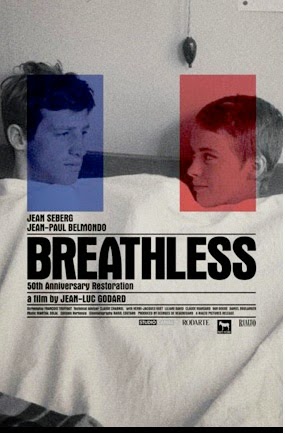
The French New Wave pt.1 "Breathless"


In the 1960's film goers who wanted something different to talk about over drinks and dinner flocked in droves to see films like Breathless by Jean-Luc Godard, and Jules and Jim by Francois Truffaut.  These films were hip and groundbreaking, thought provoking, and fun. They showed cool people doing and saying cool things. It's hard to believe it now, but Breathless was the Pulp Fiction of the 60's.  Breathless ushered in a new kind of film making. Jean-Luc Godard was a rock star and his films played like a punk concert.  The characters in the films displayed morals as loose as the roaming camera work. Scenes were shot on location (busy city streets, cafes, record stores, cheap hotels). No extras were employed and no sets were built. The style of film making was branded The French New Wave (or simply New Wave).


The Plot of Breathless is a spin on the American crime drama. A French Hood , Michel (Jean-Paul Bemando), shoots a police man in Marseilles while trying to steal a car. While on the run he turns to his American girlfriend, Patricia (Jean Seberg), who lives in France. Patricia is an aspiring journalist who sells newspapers on the street corner. She spends much of the film contemplating whether or not she is really in love with Michel. She reluctantly hides him out in her apartment as they ponder their relationship and the relationship between men and women in general.  Michel aspires to be like the screen hero Humphrey Bogart, aloof and unaffected. Able to remain detached when it comes to women and life. He constantly makes comments about his disregard for love and people. Patricia listens mostly and shrugs him off, then shoots back with her own witty retorts. She is truly the one who is detached. She says it all with her seductive, capricious eyes and coy smile. She toys with the idea of being in love with Michel, as if it were something she could take or toss away.  Even when telling him she is pregnant with their child. Patricia doesn't seem particularly loyal or committed to him.

( Writer,Director Jean-Luc Godard)

This aloof and ambivalent attitude toward life, love, and society was groundbreaking at the time. People went to see movies where the hero was tough and cool but had a moral compass, and the women were sexy and stunning but always stood by their man while taming the bad boy in him. Breathless has none of that. Michel is not as tough as he believes, although his contempt for anything in society plays as cool and smooth. We laugh as he insults everything life has to offer (including one scene where he is in his car and looks directly into the camera to rant about bad drivers and how much he hates the countryside). Patricia is sophisticated and modern, even by today's standards. She doesn't let her affection for Michel affect her decisions about life and what is best for her and her baby (though it is his.) They are both a couple of smart ass cool kids but appear leaps and bounds above the intelligence factor you see in today's films. As I watched this film again recently I was amazed at how relevant the dialogue was between them. These are conversations intelligent people have today! Not stylized versions of conversations, but true back and forth talking, For something new and different check out this not so "old" classic!


Tuesday, April 23, 2013

Django Unchained (The importance of Quentin Tarantino)


The first screenplay I purchased was Pulp Fiction. I had just started writing screenplays and I was sort of a wide eyed kid with wonder - this was a new and exciting world I had discovered. Then I read Pulp Fiction and I have never been the same since. Tarantino was breaking all of the rules - his characters and dialogue drove the plot, rather than the plot driving the characters. This was something highly unusual in most successful American Hollywood films. I realized that the only rule was to entertain the audience. Yes you must be a skilled writer and you must know your craft, but if the audience isn't entertained none of that matters.


Which brings us to Django Unchained. A film that has gotten many mixed reactions, of course controversial reactions that Tarantino is a racist for using the word "nigger" more times than we can count. I remember when Jackie Brown came out and he got the same reaction. We must first realize that Tarantino grew up loving the Blaxploitation films of the 70's with Pam Grier. During that period of time "politically correct" wasn't a term. What was important was ENTERTAINMENT. What Django brings to cinema is a tribute to both the old Westerns and the Blaxploitation films. There is social commentary but first and formost, we are entertained by an exciting and bold film.


Right away Tarantino throws us into the old west where slaves are being marched through the desert and the woods in leg irons, led by two white men on horses. We know we aren't dealing with a typical John Wayne western.  They are interupted by a German man with a horse and carriage who goes by the name of Dr. King Schultz. He frees one of the slaves named Django. We don't know why exactly, but we come to find that Dr. Schultz is not a doctor but a bounty hunter and he needs young Django to hunt down three wanted men that were once Django's owners. What follows is a wonderful adventure as they form a dynamic partnership. We find out that Django is also married and that his quest is to find his wife. There is also a line that could only be delivered by Jamie Foxx (Django) when he is being taught by the great Christopher Waltz (Dr. Schultz) to become a bounty hunter; "Get payed for killing white people? What's not to like?"


There are many human moments that balance out this sort of dark humor - human moments that make the movie really work. That is what filmmakers forget when they are trying so hard to shock audiences. Tarantino takes his time to let you get to know these characters and why they are behaving the way the are behaving. There are no throw away scenes in this two hour and fourty-five-minute film. In the second half of the film we meet Leonardo DiCaprio's character Calvin Candie, a plantation land baron who also has possession of Django's wife Broomhilda. DiCaprio plays one of the best villains in cinema history, His charm and charisma make him all that more evil. But worse than Calvin Candie is Samuel L. Jackson as his "house slave/assistant". Jackson steals the show in his short screen time. Tarantino knows how to use his talent. I have heard Tarantino say in interviews that Sam Jackson recites his lines like poetry, and I completely agree.


 What Tarantino does with every film, is give you something you aren't quite expecting. When you feel the movie going one direction he takes a turn. He does this through dialogue, through plot, and of course bizarre music that pops up during unexpected moments (The ear cutting scene with Michael Madsen in Reservoir Dogs). This is a filmmaker that truly loves cinema and entertaining his audience. Are we uncomfortable sometimes? Of course. Because if we get too comfortable with a film we know exactly where it's going. And what's the fun in that?


Wednesday, October 17, 2012

The Descendants (Clooney, the modern Cary Grant?)


George Clooney has the charm and looks to play a typical ladies man, but he never does. He always chooses to play his roles with a dark sense of humor, a sly wit, as if he is winking at the audience. Clooney doesn't take himself too seriously and therefore creates an even more attractive character, a character that lets the audience in rather than alienating them to admire him from afar.  Another actor who had this ability and did it better than anyone was the immortal Cary Grant.  Never has this characteristic been more present than in George Clooney's role as Max King in director Alexander Payne's The Descendants.
Payne is known for dark comedies that border on tragedy: Election (1999, Reese Witherspoon, Matthew Broderick), About Schmidt (2002, Jack Nicholson), and Sideways (2004, Paul Gimatti and Thomas Hayden Church). His films deal primarily with men who are very very flawed and are somehow seeking, although not always successfully, some sort of redemption and peace of mind. Max King opens the film with his narration; " My friends on the mainland think that just because I live in Hawaii, I live in paradise. We're all just out here sipping Mai Tais, shaking our hips, and catching waves. Are they insane? Do they think we're immune to human life?"


Max King is a descendant of one of Hawaii's first white land owning families (his great great grandmother was Hawaiian and his great great grandfather, white). He faces a decision about whether to sell his land to tourist and condo development, therefore making his large collection of broke relatives rich, or hold on to the sacred integrity of the virgin land. While this is happening Max faces a traumatic crisis with his wife who, as of 23 days ago, has slipped into a coma after a tragic boating accident. He is faced with the realization that his wife is not going to recover, and that she has left instructions in her will to be taken off of life support.
Max is left with the task of informing all of their friends and relatives about her death. He recruits his two dysfunctional daughters Alexandre (17) played by Shailene Woodley and Scottie (10) played by Amara Miller to come along for emotional support.  As this task is set in motion Max finds out that his wife was having an ongoing affair right up until her accident. If it seems as though I am giving too much away, I assure you I am not. This is all set up very quickly and the rest of the film deals with what follows. There are so many great characters, including Alexandre's boyfriend Sid (Nick Krause), who accompanies Max and his daughters throughout the film. There are a couple of scenes where he steals the show.


 Hawaii plays a huge role in the film, not just as a back drop, but really as a central character. Max deals with the sub plot of his connection with the land as he deals with the loss of his wife, and his reconnection with his daughters. Much is to be said for Clooney's ability to work with younger, less experienced actors and really make them shine. He did it with Anna Kendrick in Up In The Air also. She spoke very highly of his coaching and supportive advice during filming. Another actor was known for doing this with his less experienced co-stars, once again Mr. Cary Grant.


Cary Grant made other actors look good, and no one knew what he was doing behind the scenes to accomplish this. Clooney is that kind of actor. We want to watch how everyone reacts to him and what they will do next. This is very rare when dealing with such a high profile celebrity. The relationship between Max and his daughters is adorable, but not simple. He is trying so hard but he just doesn't quite get what it is he is supposed to get from all of this tragedy. He wants to get it, he really does, but like many of us he fumbles awkwardly and blindly trying to figure out what "it" is. 


Sunday, September 16, 2012

Take Shelter


In my last movie blog I talked about symbolism in the Kubrick masterpiece Eyes Wide Shut, a film that seemed to be purely symbolic. Take Shelter is a film where the symbolism is also very literal. That is, it works both as a purely symbolic work and also a very real thriller aimed at the heart of America. Curtis LaForche (played by Boardwalk Empire's Michael Shannon) is a loving husband, a caring father to his hearing impaired daughter Hannah (Tova Stewart), and has a decent job as a construction worker.  He is the everyman from Ohio and the contented soul many of us would envy.
This is all good until he starts having nightmares that seem so real they are more like visions. He dreams the family dog will attack him, that storms are coming, he wakes up with morning panic attacks. Knowing that the dreams might mean something, he makes a pen outside for the family dog. His wife Samantha (Jessica Chastain) is bothered by this because the dog is a house dog and has always been friendly with his daughter. His dreams of the storms persist and now he is seeing actual clouds gathering on the horizon - dark ominous and coming for his family. Director Jeff Nichols adds a stroke of brilliance by showing these clouds gathering above Curtis when he is awake and then drizzling and oily rain onto his hands, suggesting that what Curtis is sensing is real.  Also, Curtis lives in an area where people have storm shelters and tornadoes are common.


Much like the Richard Dreyfuss character in Close Encounters Of The Third Kind, Curtis is driven by something only he can see and something only he knows the importance of. 
Curtis begins borrowing equipment from work and getting loans to build out his storm shelter. He seeks help from local mental health physicians who aren't really qualified. We find out Curtis' mother was diagnosed with mental health problems, and now lives in an assisted living home. He visits her to find out if he some how has inherited this gene in his psyche. Nothing is making his visions go away and he is a man holding on by the threads of sanity. 
This movie is unique because the director doesn't harp on the usual melodrama that we would expect. Samantha is terrified but she doesn't turn on her husband even though the whole town thinks he is insane. Curtis doesn't become abusive or unidentifiable as he loses his grasp on reality.  This is a sincere film about something many of us are feeling right now, that the world  is not right. No matter what we believe, no matter what our political affiliation, we know there are storms brewing and we can see them as clear as if they were right on our door step. You don't have to watch the news to know this, this feeling is everywhere.


In Take Shelter there is a "twist ending", but not so much of a twist that you go "come on!" No, this twist ending is like the rest of the film, subtle and brilliant.  I for one am fed up with twist endings that seem to come from out of nowhere and have absolutely nothing to do with the plot. Does anyone else agree?? Also, this is not a depressing film. This is an aware film. There is a difference, to me anyway. Above all this movie is an enjoyable ride. The actors are brilliant, the directing and writing top notch, and no special gimmicks are needed to make this happen. Just pure marvelous film making - kind of like the old days before CGI.


Wednesday, August 22, 2012

POWER TO THE FEMALE!

 Among the many excellent tunes I have blasting from my speakers right now, the females are impressing me the most. Last year female releases dominated music with Jill Scott, The Joy Formidable, Beyonce, Tune-Yards, Sophie Hunger, Little Dragon, Lady Ga Ga, St.Vincent,Wild Flag, Nneka and many many others. 2012 hasn't shown signs of turning the reigns over to males anytime soon. As Beyonce says in her female anthem Run The World (Girls); "My persuasion can build a nation".


FIONNA APPLE - THE IDLER'S WHEEL IS WISER THAN THE DRIVER OF THE SCREW AND WHIPPING CHORDS WILL SERVE YOU MORE THAN ROPES WILL EVER DO:  Fionna Apple doesn't just redefine dark music with bitter soul, she IS dark music with bitter soul. She owns pain in away few other artists ever have. Pain is her muse and we the audience benefit greatly. Fionna has kept this album a great secret for six years, allowing no press or visitors of any kind. Unique to her approach is the use of only acoustic instruments, as in only real pianos, real drums, and acoustic upright bass. So the result is incredible on the numbers when she goes off into jazz passages. The percussion of the stand up bass echoes beautifully with the resounding boom of her piano, not many pianists can make a piano boom like Fionna! And of course those lyrics..."My heart's made of parts of all that's around me, maybe that's why the devil just can't get around me."


NORAH JONES - LITTLE BROKEN HEARTS: Lookout Fionna Apple, Norah Jones got dark too! Perhaps because this album came after a nasty break-up. She and producer Danger Mouse(who co-wrote and played on the album as well) went into the studio with no songs written before hand. The two collaborated brilliantly on two songs from Rome(Last year's fictional Italian movie soundtrack by composer Daniel Luppi and Danger Mouse).  Little Broken Hearts delivered on Rome's promise. She speaks here about heart break in a much heavier way than anything she has previously attempted. Norah even threatens to kill the female that stole her man!"Now I'm not the jealous type, never been the killing kind. But you know I know what you did, so don't put up a fight." I am so proud of my longtime crush Miss Norah Jones! And Danger Mouse has proven he has consistent brilliance.


REGINA SPEKTOR - WHAT WE SAW FROM THE CHEAP SEATS: This one goes down as the sweetest and most hopeful album I have heard this year. Regina Spektor is optimistic about trauma without denying the weight of life's burdens. Consider the following lyrics: "Love what you have and you'll have more love. You're not dying...Everyone knows you're going to love...though there's still no cure for the crying." Spektor was born in Russia but studied classical piano in New York, this might account for her unique sound. One can hear touches of The Beatles (specifically Abbey Road) , and also circus-like melodies, something you might hear from Doris Day if she hung out with Neil Young. But none of that is to say this is retro. No What We Saw From The Cheap Seats is totally modern in it's concepts and production value. Music for broken hearts that refuse to quit smiling.


EMA - PAST LIFE MARTYRD SAINTS:  I always get a little more curious about just what Erika M. Anderson(EMA) has come up with here. This is an album you can purchase and still be chewing on a year later. I knew I liked it, but I couldn't tell you exactly why or what it was. Her attitude is punk, her sound is hypnotic, with vocals that land between spoken word and a soulful howl - bringing to mind Sonic Youth, Nirvana, Bjork, The Flaming Lips and even R.E.M. There's really only one real rocker on the album, Milkman(also a single), but not once does Past Life get boring or soft. Every song presents a different style and form, there is no uniform structure on the whole. So obviously I still can't figure EMA out, but I can't wait to see what she comes out with next. I am hooked!


SHARON JONES AND THE DAP KINGS - I LEARNED THE HARD WAY: This album came out in 2010 but it could have been released in 1960 on Chess Records. It is impossible not to hear Etta James and Ruth Brown in the powerhouse voice of Sharon Jones. The Dap Kings hail from Brooklyn, NY and have pioneered a revivalist movement of  60's funk and Soul on their own label Daptone Records. In order to achieve this sound they have done away with all digital recording, going with only older analog equipment (a technique also favored by Jack White of The White Stripes) and through using vintage instruments as opposed to updated equipment. Charles Bradley's 2011 album No Time For Dreaming (also on Daptone Records) follows this same format, channeling the sounds of Otis Redding and James Brown. For old school Soul fans this revivalist movement is music heaven!